
REPORTAGE
What Features Make a Doll Easier to Pose

Sep
A doll can have a realistic face and premium materials but still feel difficult to pose if its internal structure is not designed well.
The ability to create natural-looking poses depends on several factors working together, including the skeleton, joint resistance, range of motion, body weight, balance, hand structure, and foot design. Some dolls can move through many positions but do not hold those positions securely. Others may have slightly less range of motion but feel more stable and predictable when posing. This is why “posable” is not just about flexibility.
A well-designed doll should provide enough movement to create natural positions while also offering enough joint resistance and balance to hold those positions without constant adjustment. Below, we will look at the features that make the biggest difference.
The Skeleton Is the Foundation of Posing
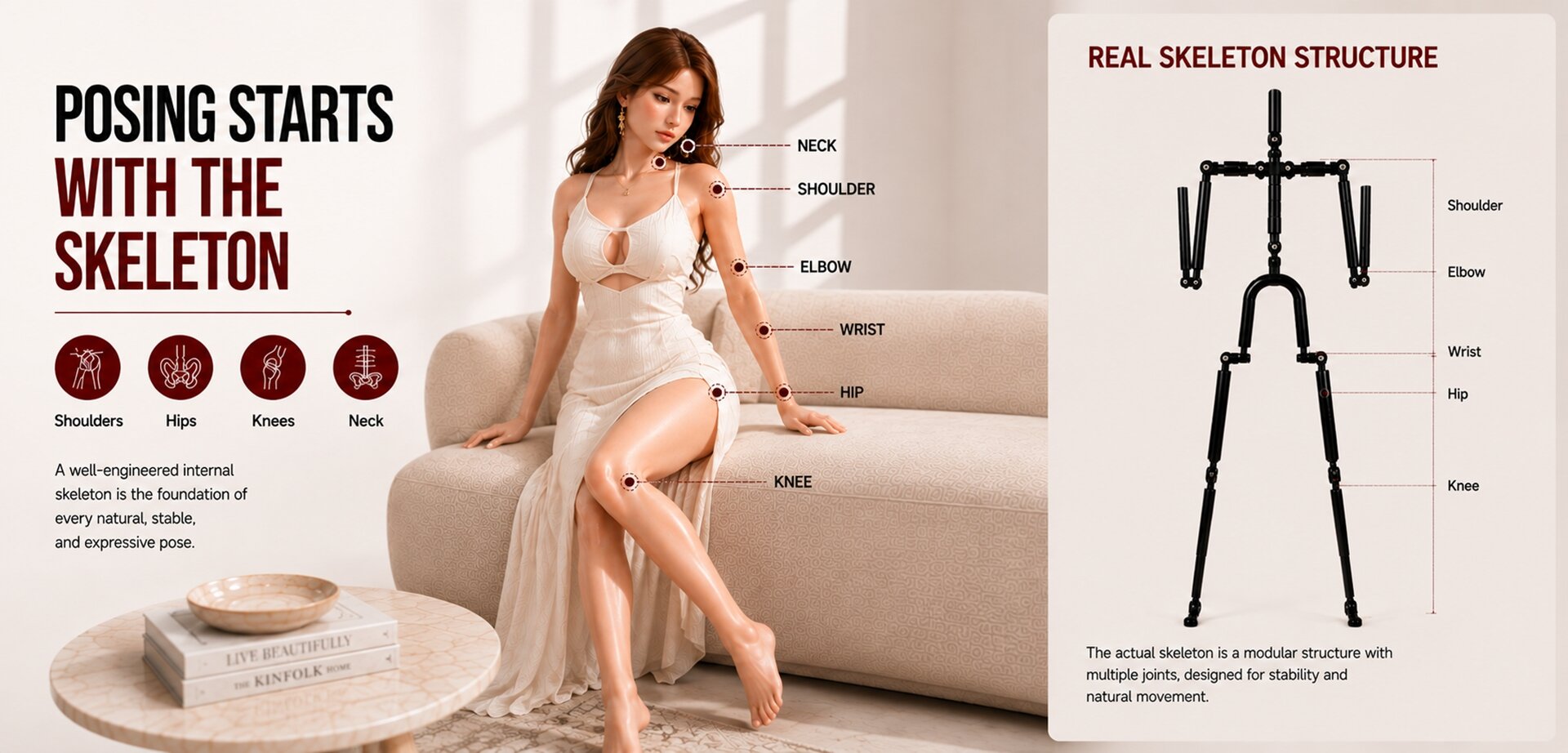
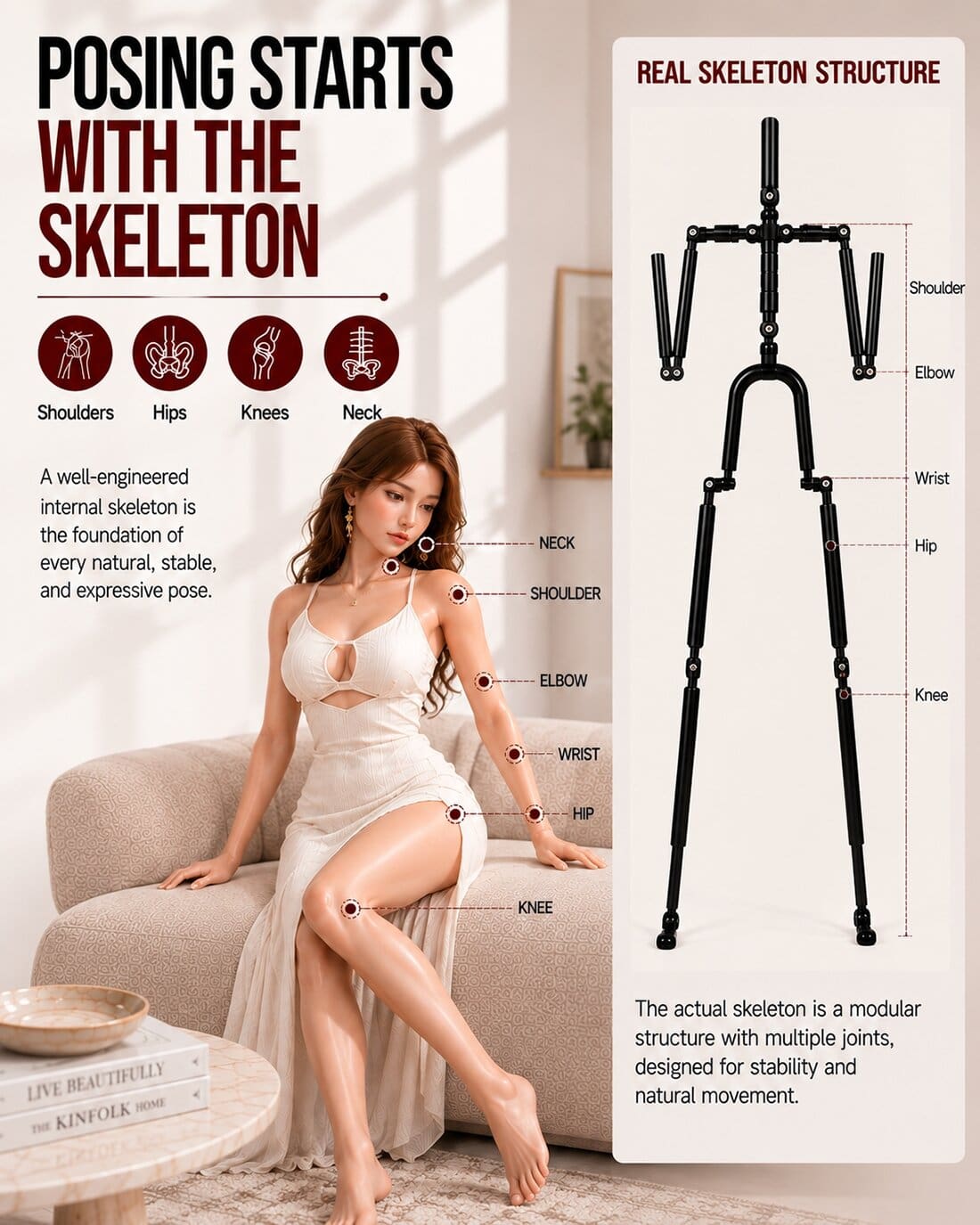
The internal skeleton is the most important mechanical system behind a doll’s posing ability. A well- designed articulated skeleton connects the head, shoulders, elbows, wrists, spine, hips, knees, ankles, and other movable sections in a way that allows the body to change position while maintaining structural support.
The number of joints matters, but joint placement and overall engineering matter just as much. A skeleton with many moving parts is not automatically easier to pose if those joints feel loose, inconsistent, or poorly balanced. The best posing systems usually combine practical range of motion with predictable resistance and stable support.
👉 For a deeper explanation of joint structure and internal articulation, see our Sex Doll Skeleton and Joint Guide.
Joint Resistance Matters More Than Maximum Flexibility
One of the most important features for posing is joint resistance.
A joint must be flexible enough to move into a natural position, but firm enough to stay there once the position is set. If the joints are too stiff, posing becomes difficult and may require unnecessary force. If the joints are too loose, the arms, legs, head, or torso may gradually move out of position. This balance between mobility and resistance is what makes a doll feel controllable rather than floppy or rigid. For most users, reliable joint resistance is more useful than extreme flexibility.
Shoulder Joints
Shoulders affect arm position, upper-body posture, and how natural the entire silhouette looks. Good shoulder articulation should allow the arms to move forward, backward, outward, and into relaxed positions without making the posture look mechanical.
Elbows and Wrists
Elbow and wrist movement strongly affects natural-looking arm positions. Small changes in wrist angle or elbow bend can make a pose look either relaxed or artificial.
Hip and Knee Joints
Hips and knees play a major role in sitting, standing, reclining, and weight distribution. These joints need enough resistance to support the lower body while still allowing natural leg positions.
Neck and Head Position
Head angle can completely change the appearance of a pose. A neck joint that allows controlled rotation and tilt makes it easier to create natural viewing angles for display or photography.
Range of Motion Should Look Natural, Not Extreme
Range of motion describes how far a joint can move, but more movement is not always better. For realistic posing, what matters is whether the available movement matches natural human posture. For example, the ability to rotate an arm or leg far beyond a natural position may add flexibility but does not necessarily improve realism.
Useful range of motion should make it easier to create normal standing, sitting, reclining, leaning, and relaxed arm positions. A doll that moves predictably through realistic ranges can often be easier to pose than one designed around maximum flexibility.
Body Weight and Balance Affect Pose Stability
Even a well-designed skeleton has to support the weight of the body around it. This means body weight and weight distribution can significantly affect how easy a doll is to pose. A heavier upper body places more demand on the spine, hips, and lower-body joints. Fuller hips or a heavier torso can also change how the doll balances when sitting or standing.
The location of the center of gravity matters as well. A pose may look visually correct but still be unstable if too much weight is positioned outside the doll’s natural support area. This is why posing is partly mechanical and partly about balance.
Lighter Does Not Always Mean Better
A lighter doll can be easier to reposition manually, but low weight alone does not guarantee better posing. Joint quality and body proportions still determine how securely the pose can be maintained.
Heavier Dolls Need More Stable Positioning
Larger or heavier dolls may require more attention to support and balance when posing. Their weight can make joint resistance and contact points more important.
Standing Feet and Foot Design Can Improve Posing
Foot design becomes especially important when standing poses are part of the intended use.
Some dolls include reinforced or standing-compatible feet designed to support upright positioning under appropriate conditions. The size of the feet, ankle articulation, body weight, joint resistance, and floor surface all affect standing stability.
Even with standing feet, users should not assume that every doll can remain upright safely without support. Standing capability should always be evaluated according to the manufacturer’s specifications and the individual model’s design.
Finger Skeletons Make Hand Poses Look More Natural
Hands are one of the most noticeable details in realistic posing. Some dolls include articulated finger structures that allow individual fingers to be adjusted into more natural-looking positions. This can make a significant difference in photography, display, and everyday posing because stiff or identical finger positions often look artificial.
However, finger structures are more delicate than major body joints and should be adjusted carefully according to the manufacturer’s instructions. The goal is not extreme finger movement, but subtle and believable hand positioning.
Body Proportions Also Influence How Natural a Pose Looks
Mechanical posing ability and visual posing quality are not exactly the same thing. A doll may technically hold a position but still look unnatural if the body’s proportions do not work well with that pose. Shoulder width, arm length, torso length, hip width, leg length, hand size, and head proportions all influence the final silhouette. Balanced proportions usually make common sitting, standing, reclining, and relaxed poses look more convincing. This is one reason realistic doll design involves more than simply adding flexible joints.
👉 You can explore our Realistic Sex Dolls collection to compare models designed with lifelike proportions and detailed body styling.


Posability and Pose Stability Are Not the Same Thing
A useful distinction when comparing dolls is the difference between posability and pose stability. Posability refers to how many different positions the doll can move into. Pose stability refers to how well the doll can maintain those positions once they are set.
A doll with a very wide range of motion but weak joint resistance may be highly flexible but frustrating to pose. A doll with slightly more limited movement but strong, consistent joints may be easier to position and photograph. For practical ownership, both qualities matter.
What Features Should You Look for in a Posable Doll?
When comparing dolls for posing ability, focus on the complete mechanical and physical design rather than one specification.
- Articulated internal skeleton
- Consistent joint resistance
- Natural range of motion
- Stable shoulder and hip joints
- Controlled neck movement
- Strong knee and ankle support
- Standing-compatible feet where available
- Articulated finger structures
- Balanced body proportions
- Manageable overall weight
- Clear manufacturer posing guidance
Not every doll includes every feature, and different designs prioritize different types of movement. Review the individual product specifications to understand how the skeleton, joints, feet, hands, and body construction are designed.
Does Better Posability Make a Doll More Realistic?
Better posing ability can improve visual realism because natural posture strongly affects how a doll looks. A realistic face and skin finish can appear less convincing if the shoulders, arms, hands, knees, or head are positioned stiffly. Conversely, subtle changes in posture can make the same doll appear much more natural in photography or display.
However, posability is only one part of realism. Facial sculpting, materials, skin texture, body proportions, hair, eyes, and craftsmanship still contribute to the overall result.
👉 To compare different body styles, materials, sizes, and articulation options, explore our complete Sex Dolls collection.
Frequently Asked Questions
A well-designed articulated skeleton, consistent joint resistance, natural range of motion, balanced body weight, stable feet, and controlled neck, hip, shoulder, knee, and arm joints can all make a doll easier to pose.
No. Very loose or extremely flexible joints may make a doll harder to position securely. Useful posing usually depends on a balance between mobility and resistance.
Loose joints, uneven joint resistance, poor weight distribution, heavy body sections, or unstable support points can all affect pose stability.
Articulated finger structures can make hand positions look more natural, especially in photography and display. They should be adjusted carefully because finger components are smaller and more delicate than major body joints.
Standing-compatible feet can help with upright positioning on suitable surfaces, but overall stability still depends on body weight, ankle and leg joints, balance, and the specific model design.
Yes. Weight affects how easily the doll can be repositioned and how much load is placed on joints and support points. Heavier dolls may require more careful balancing.
Many articulated dolls can be positioned in natural seated poses when the hip, knee, spine, and ankle joints provide sufficient range of motion and resistance.
Review skeleton type, joint design, range of motion, standing features, finger articulation, body weight, dimensions, and manufacturer guidance rather than relying only on promotional photos.
Good Posing Comes From Control, Not Just Flexibility
A doll is easier to pose when its skeleton, joints, balance, body weight, and proportions work together. Maximum flexibility is not the goal. The most practical designs provide controlled movement, enough joint resistance to hold natural positions, and stable support through the shoulders, hips, knees, ankles, hands, and feet. Features such as articulated fingers and standing-compatible feet can further improve posing options, but their value depends on the complete design of the doll.
If posing matters to you, look beyond the phrase “articulated skeleton” and examine how the joints, weight, proportions, and support features actually work together. A doll that moves naturally and holds its position reliably is usually more useful than one that simply offers the widest possible range of motion.
👉 Learn more about Sex Doll Skeletons and Joints

Alice
Lead Product Specialist & Collector Consultant
At Linkooer
Alice began her journey with these unique artistic creations in 2019. Starting on the front lines of collector services, she quickly distinguished herself through a deep understanding of the craft and an even deeper connection with the community. Today, she is Linkooer's most trusted voice, dedicated to helping enthusiasts of all levels find the piece that truly speaks to them.
